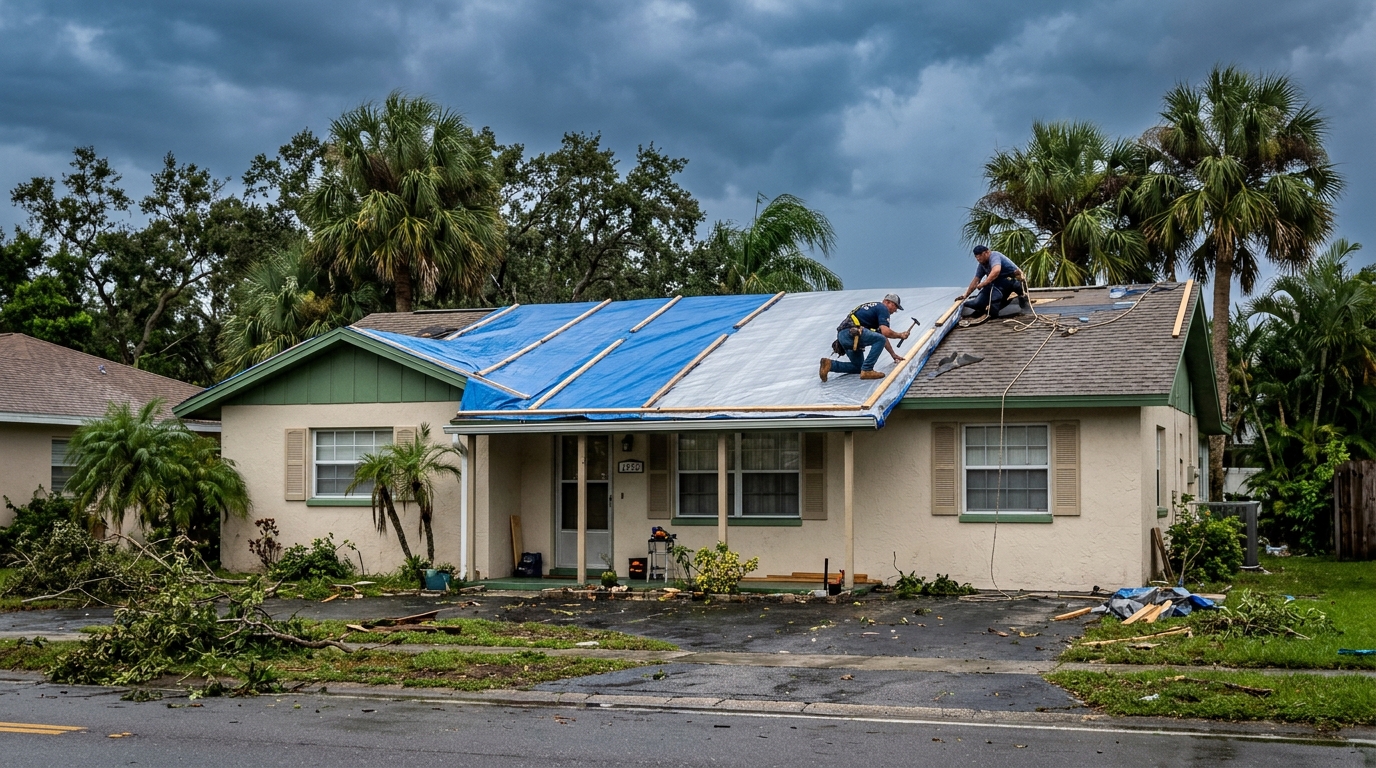
Emergency Roofing Response in Madison, AL
Situated immediately west of Huntsville, Madison has experienced rapid residential growth with extensive master-planned communities across County Line Road, Hughes Road, and Mill Creek. The community’s prevailing residential architecture predominantly features multi-gabled, steep-slope architectural asphalt shingle roofing systems. Located along the open expanse of the Tennessee Valley floor, Madison homes face unhindered straight-line wind gusts and convective supercells. High-velocity inflow drafts frequently break the adhesive sealant bonds on dimensional architectural shingles, tearing starter strips and exposing raw OSB decking along eaves and rakes.
When catastrophic storms strike Madison, AL, prompt dispatch of experienced emergency roofing crews prevents progressive structural decay. Water entering torn shingle fields or punctured decking quickly infiltrates insulation cavities, ceiling drywall, and structural framing. Calling RoofExpertUSA dispatch at (888) 208-4155 provides immediate, direct connection to licensed, insured independent roofing contractors prepared for immediate mobilization.
Our dedicated operational protocol for Tornado Wind Shingle Strip Tarping in Madison guarantees that emergency containment procedures are calibrated precisely for the local building styles and storm vulnerabilities of Madison, AL.
1. Local Microclimate Dynamics & Severe Storm Hazards in Madison, AL
The microclimate of Madison, AL is shaped by its geographical placement within the Tennessee River Valley and the Cumberland Plateau foothills. Convective storms sweeping across Northern Alabama interact intensely with localized terrain. As storm fronts encounter undulating ridges and river boundaries, updrafts compress and generate severe downburst wind vectors exceeding 75 to 80 mph.
In addition to high-velocity winds, severe thunderstorms in Madison, AL produce intense cloud-to-ground lightning, hail, and torrential downpours dumping up to 3 inches of rain in under an hour. Rapid rainfall overwhelms residential gutters and valley flashings, generating backwater surges that force moisture behind fascia boards, beneath starter shingles, and through aging brick chimney counter-flashings.
2. Non-Destructive Moisture Diagnostics & FLIR Thermal Tracing
Effective emergency mitigation requires precise identification of water entry points without tearing away viable roofing components. Dispatched technicians in Madison, AL utilize non-destructive diagnostic tools conforming to international building and insurance standards:
- FLIR Infrared Thermal Scanning: Identifying concealed wet insulation and hidden ceiling moisture plumes through temperature differential mapping during post-sunset thermal dissipation.
- Dielectric Moisture Meter Verification: Measuring sub-surface moisture content in roof decking and framing members without puncturing weather barriers.
- Forensic Haag Hail Test Squares: Quantifying impact densities per 100 square feet and distinguishing functional hail bruises from mechanical wear, blisters, or thermal cosmetic degradation.
- Borescope Fiber-Optic Attic Inspection: Evaluating structural rafters, collar ties, and wood sheathing for active leaks, delamination, and fungal growth.
Localized Microclimate & Repair Protocols: Madison, AL
- Orographic High-Wind Fastening: Utilizing 6-nail fastener patterns with enhanced ring-shank nails to resist extreme aerodynamic uplift along ridge lines.
- Mechanical Batten Tarp Securing: Fastening 10-mil polyolefin tarps with dimensional lumber battens anchored into rafters rather than thin sheathing.
- Self-Adhering SBS Ice & Water Membranes: Applying high-temp modified bitumen membranes in all valleys, eaves, and sidewall transitions to prevent backwater infiltration.
- Non-Destructive Historic Access: Utilizing hook-secured ridge ladders and padded walk-boards to protect delicate steep-slope substrates in historic enclaves.
3. Step-by-Step Substrate Restoration Methodology
Restoring storm-damaged roofs in Madison, AL follows an orderly, forensic sequence engineered for long-term weather resistance and insurance claim integrity:
- Immediate Site Stabilization & Hazard Containment: Securing electrical hazards, establishing fall-protection anchor points, and stabilizing loose debris or tree branches.
- Water Extraction & Temporary Barrier Installation: Applying heavy-duty polyolefin tarps or shrink-wrap membranes over exposed decking to prevent interior water damage.
- Forensic Damage Documentation: Compiling high-definition photographs, video walk-throughs, and moisture mapping logs for insurance claim validation.
- Decking Repair & Sheathing Replacement: Removing water-softened or fractured plywood panels back to rafter centers and installing exterior-grade CDX plywood or OSB.
- Permanent Roofing Installation: Installing synthetic underlayments, high-grade architectural shingles, slates, or single-ply membranes conforming to Alabama building codes.
4. Alabama Building Codes & Contractor Licensing Compliance
Every roofing repair project coordinated through our dispatch network adheres to the 2021 International Residential Code (IRC) and municipal amendments enforced in Madison, AL. In accordance with Alabama state statutes (§ 34-14A), residential roofing restoration projects exceeding \,500 must be conducted by licensed professionals certified by the Alabama Home Builders Licensure Board (HBLB).
Commercial projects exceeding \,000 require active licensing from the Alabama Licensing Board for General Contractors. Independent contractors dispatched through RoofExpertUSA maintain full licensure, commercial liability policies, and statutory workers’ compensation coverage, protecting property owners from financial liabilities during emergency triage and permanent reconstruction.
5. Preventative Property Maintenance & Severe Storm Preparedness
Homeowners and facility managers in Madison, AL can significantly reduce storm vulnerabilities by adopting ongoing preventative measures:
- Oak & Pine Canopy Clearance: Maintain at least 10 feet of vertical and horizontal branch clearance from all roof surfaces to prevent shingle abrasion and limb-drop damage.
- Bi-Annual Valley & Flashing Checks: Clear debris dams from valley troughs and inspect chimney step flashings and masonry counter-flashings before spring tornado seasons.
- Continuous Attic Ventilation: Maintain balanced ridge vents and soffit intakes to reduce attic heat buildup, extending shingle adhesive strip lifespan and preventing deck warping.
- Plumbing Vent Pipe Boot Inspection: Inspect rubber boot seals around PVC vent stacks annually; replace UV-hardened collars before dry-rot initiates concealed attic leaks.
Frequently Asked Questions: Emergency Roofing in Madison, AL
When you call our 24/7 dispatch desk at (888) 208-4155, we triage your emergency immediately and route the call to verified independent roofing crews operating directly within or adjacent to Madison, AL. Emergency stabilization is prioritized based on structural severity and active interior water intrusion rates.
Please provide your property address in Madison, AL, the approximate roof pitch, the suspected damage cause (hailstone impact, high-wind shingle uplift, fallen limb, or valley leak), the number of active leak locations indoors, and whether electrical panels or wiring are affected by water intrusion.
Yes. Dispatched independent contractors provide comprehensive photographic logs, moisture meter readings, and line-item mitigation invoices conforming to standard insurance estimating platforms (such as Xactimate), satisfying your policy’s damage mitigation requirements.